Posts
How to Reduce High Ammonia in Fish Tank
- Get link
- X
- Other Apps
Maintaining a healthy environment for your aquatic pets is essential to their well-being and longevity. In an aquarium that is not properly established or maintained, ammonia can accumulate and reach harmful levels for fish. Ammonia in a fish tank Ammonia is a toxic substance that is released by fish waste and decaying matter, it can be detrimental to the health of fish. The main sources of ammonia are fish waste, uneaten food, and decaying organic matter such as dead plants or fish. Ammonia is produced through the breakdown of these organic substances by bacteria. In a healthy aquarium , beneficial bacteria called nitrifying bacteria convert the toxic ammonia into less harmful substances, through a process known as the nitrogen cycle. Initially, ammonia is converted into nitrite (NO2-) by bacteria called Nitrosomonas. But Nitrite is still toxic to fish, so another group of bacteria called Nitrobacter converts it into nitrate (NO3-), which is less harmful to fish in low to moderate con...
Top Seven Aquarium Stones for Aquascaping - Pine bark stones
- Get link
- X
- Other Apps
How to culture nitrifying bacteria for fish tank
- Get link
- X
- Other Apps
When we build a new fish tank, it means that we should cultivate the nitrifying bacteria and other beneficial bacteria in the water and keep them a relative balance first. Among all the beneficial bacteria, nitrifying bacteria is the most essential one for clear water. What do nitrifying bacteria do in aquariums? The excrement of fish and the residual feed after feeding are decomposed into ammonia and nitrogen in the tank. Ammonia and nitrogen are poisonous, and fish will be poisoned or even die if they live in an environment where ammonia and nitrogen exceed the standard for a long time. So it requires nitrifying bacteria to decompose the ammonia and nitrogen and build a balanced ecosystem for the tank creatures. First, nitrifying bacteria decompose ammonia and nitrogen and produce nitrite, and then it decomposes the nitrite into nitrate. Nitrates are low toxicity and basically harmless to the tank inhabitants. It can be diluted with regular water changes. Where is the aquarium nitrif...
Enhance the Effectiveness of Physical Filtration in Fish Tanks
- Get link
- X
- Other Apps
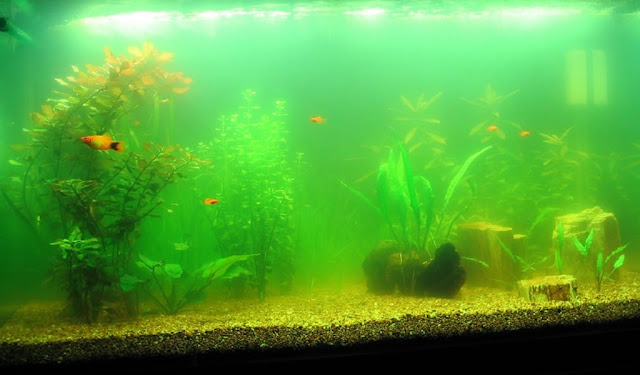
Algae in the fish tanks Brown algae are inevitable in a fish tank. Algae eaters can solve the algae problem. However, how to get rid of green water? It is due to the effectiveness of physical filtration in the fish tank. Chlorella in the fish tank is supposed to exist anytime because the spore is airborne. Physical filtration can remove most of the impurities in water, as long as the water quality will not overly fertile, even a little chlorella in the tank, all can be intercepted by these aged filters. Tank green water Overcrowding tank If the proportion of fish and aquatic plants in the fish tank is unreasonable, it will cause overstocking in the tank. It leads to the result that the fish tank filter can't filter out the debris completely, causing the algae to grow too fast and form green water. Overfeeding When you overfeed the fish, a large amount of food will rot and deteriorate in the water, this is the nourishment of algae, and more green algae will...
Up to 50% off Hygger Heater for Saltwater Freshwater
- Get link
- X
- Other Apps
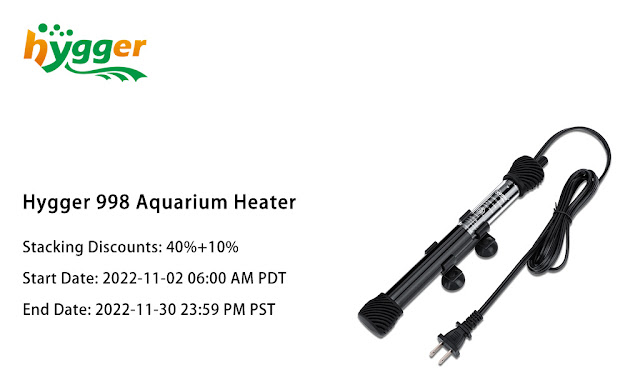
Product Name: Hygger 998 ETL Certification Aquarium Heater Available Size: 50W 100W 200W 300W Reg. Price: $13.99-$21.99 Final Price: $6.99-$10.99 Start Date: 2022-11-02 06:00 AM PDT End Date: 2022-11-30 23:59 PM PST It is time to add the 50% discount on your shopping cart now, please go to: Hygger ETL Certification Aquarium Heater, 50W/100W/200W/300W Submersible Fish Tank Thermostat Heater with Adjust Knob Suction Cup for Small Betta Coral Saltwater and Freshwater